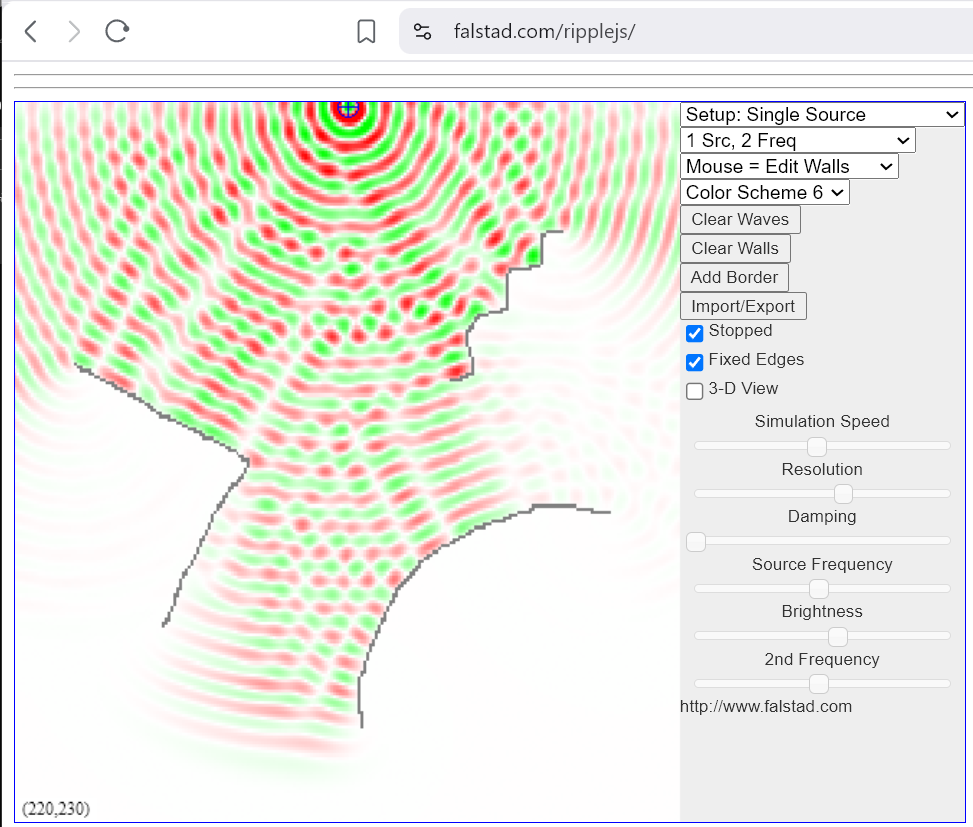
One of my eureka moments working on audio products came about ten years ago, when I found this little web-based simulation tool called ripple.js:
https://www.falstad.com/ripple
It helped me understand how sound waves interact with geometry. I encourage any non-engineer working on audio products to spend some time playing around with it.
I discovered this when I was working on a baffle concept for the Neumann KH 120. Back then, I proposed clean, minimal, "Apple-esque" designs, but the Neumann team told me that these designs won't work.
My intuition was that a visually simple form would also be acoustically clean.
But the opposite was the case.
The KH 120 baffle looks very smooth for a reason. Sharp edges close to an audio transducer cause diffraction: The effect when Sound waves bend and spread when they encounter an edge or obstacle. This results in new sound waves which influences the direct sound from the speaker, which is a bad thing if your goal is perfect audio. (The KH 120 baffle is mathematically modelled to control this effect.)
It made me think of riding a bicycle over an improvised ramp as a kid. You immediately feel the transition when you hit the ramp. You feel the compression and the vibration and change of direction. It's not 100% the same but soundwaves also react to geometry. The strange thing for me was that different frequencies react differently to the same shapes. It was not intuitive to me, maybe because sound is invisible...Ripple.js tank visualizes the soundwaves which is why I liked it.
The picture shows a screenshot of ripple.js, with a few shapes I scribbled and how sound interacts with those shapes. Of course, reality is much more complex because it's 3 dimensional and you have materials and all other frequencies to deal with.
This post was first published on LinkedIn: https://lnkd.in/p/edyeZceq