
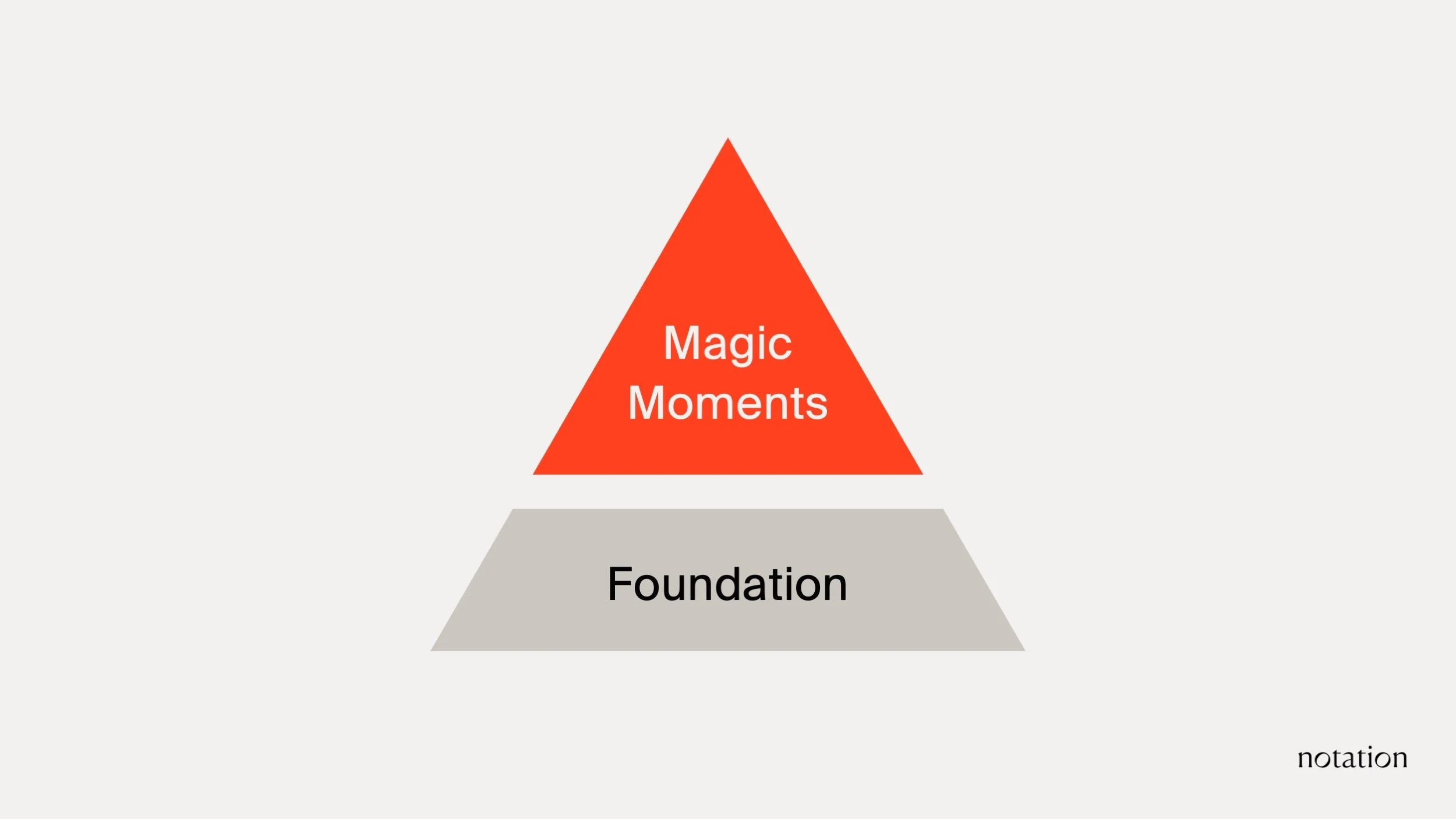
The foundation of Magic Moments
"Wow, this was unexpected,
I love this product!"
Reactions like this don't come from higher investments into design execution. They come from four strategic decisions made before any design work begins:
Who exactly you're designing for (focused target audience)
What world they live in (deep customer context)
How you fit into that world (strategic positioning)
Why should customers care about us (product vision)
It’s not allways easy to answer those questions. Not because they're intellectually difficult, but because answering them forces uncomfortable choices. It's easier to keep your options open, by trying to serve multiple audiences, or start building features immediately.
Without the proper strategic foundation, you'll probably create products that work. But you don't create experiences that wow your users.
1. It all starts with the customer
You cannot create magic for everyone. Magic moments - those surprising, delightful, and intriguing experiences - emerge from a deep understanding of your users, and this requires focus.
This means choosing a specific audience within a specific industry vertical. Not "B2B SaaS users" or "mid-sized companies." Something like: "Product managers at 50-200 person SaaS companies in healtcare-tech."
The narrower your focus, the deeper your understanding will be. The deeper your understanding, the more precisely you can design moments that make users think: "Wow, that was unexpected!"
What to avoid: Your target audience needs multiple "and/or" statements. If you're serving enterprise AND SMB, or healthcare AND finance AND retail, you've made magic moments nearly impossible.
2. Deep understanding of customer context
Most companies understand the use case - what users do with their product. But magic moments happen within an extended context.
You need to understand what happens before your product, after your product, and around your product. Ask questions like:
What's the customer doing when they first think about the problem you solve?
What happens after they achieve their desired outcome?
What are the adjacent frustrations, fears, and desires in their life?
This isn't about creating personas with demographic data. It's about understanding your customer's world well enough to see opportunities they can't articulate when asked through a survey. Observing the customer in their real world context is the most meaningful way to extract those insights.
What to avoid: Your customer research consists mostly of feature requests and satisfaction surveys. You can describe what users do in your product but not what happens in the hour before or after they use it.
3. Strategic product positioning (framed in customer reality)
Your positioning must exist within a frame your customer already understands. You can't create a new category in their mind and expect magic to follow.
Compare these positioning statements:
Bad: "The next generation of smart hearing devices"
Good: "The Sonos of hearing devices"
The second works because it borrows an existing frame (Sonos = premium, design-forward, seamless audio) and applies it to hearing devices, it does not require a lot of explanation.
It’s hard to achieve meaningful Magic Moments without Positioning. your Positioning provides that intentionality.
What to avoid: You describe your product with phrases like "innovative solution," "next-generation platform," or "cutting-edge technology" without reference to how customers already categorize products in your space.
4. Product vision (emotional + rational outcomes)
You need a clear picture of the outcome your product creates for customers. Not a feature list. Not a timeplan. A vision of what success looks like from their perspective.
This must include both emotional and rational attributes:
Rational: "Reduces report generation from 4 hours to 10 minutes" (Productivity)
Emotional: "Product managers feel confident presenting to executives" (Ease-of-mind)
The emotional component is where magic lives. Features deliver rational outcomes. Magic moments deliver emotional ones - the ones that make users say "Wow, I love that product (and brand)!"
What to avoid: Your product vision is a list of features you want to build instead of a description of how your customer's life changes when they use your product.
What "having the foundation" actually means
It's not enough to discuss these four aspects of product strategy in a meeting once. Having these prerequisites means:
They are documented (written down, not informal)
They exist before execution starts (not retrofitted)
They are shared and accessible (everyone can reference them)
They are regularly used (they guide decisions, not gather dust)
Most remarkable products I ever worked on had a good foundation in place. Without this foundation, your product will probably feel ordinary despite significant investment in design and development. It might be seamless, but not remarkable.
The real challenge
Building this foundation is not intellectually difficult. The challenge is in the decision-making process itself.
Answering these questions forces you to think critically about your entire product initiative. It requires saying no to opportunities. It demands clarity about who you serve and who you don't. It means committing to a position early on and beeing aware of your assumptions.
Ignoring the questions will probably feel faster in the beginning. But you’ll run your product into a dead end eventually. If you're wondering why your product feels flat despite significant design and engineering investments, ask yourself:
Do we have a tightly focused target audience, or are we trying to serve everyone?
Do we understand our customer's context beyond their use case?
Is our positioning anchored in a frame customers already understand?
Have we articulated the emotional and rational outcomes we're designing for?
These questions feel simple. Answering them honestly and acting on the answers requires courage. But this is the work that separates products that work from products that wow your users.
Build a proper foundation first. Magic Moments will follow.
Want to see Magic Moments in action?
Download the Magic Moments Toolbox: a 41-page PDF with 48 product examples across 16 categories. Use it as a reference for your next project or to audit your current product.
Ready to build the strategic foundation?
At Notation, we run innovation and design programs that help companies create more magical product experiences. Book a consultation to explore how you can implement Magic Moments for your products.